
Video
Lisa Thomas’ Artistic Quest for Contentment in the Weird
Art to Heart
March 20, 2026
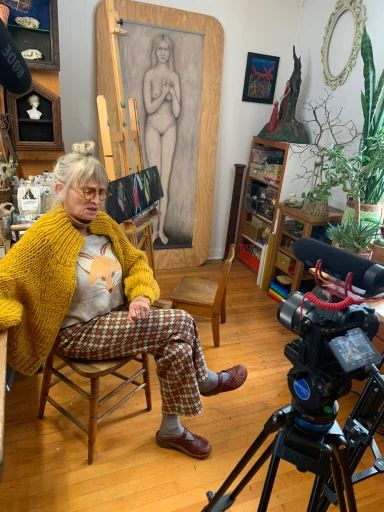
Lisa Thomas lives in the Rupert Valley, a place she describes as a paradise that keeps her in the middle of nature. This setting provides the raw material for her work, but her true focus lies beneath the surface of the trees and gardens. She admits a deep fascination with the dark underbelly of human nature. Exploring these shadows satisfies a need for understanding, helping her find a sense of calm and contentment within the inherent weirdness of the world.
Her path to this valley was rarely linear. Schooling failed to hold her interest. Halfway through grade thirteen, she quit and traveled to Mexico with a sketchbook. The local art there changed her direction entirely. Upon returning home, she joined a group of people searching for land and started a commune. It was here that she first used the land as a canvas, building gardens that avoided traditional boxes. Instead, she created shapes, spirals, and circles as a primary expression of her art.
Even when she returned to the city to study fine arts at the University of Ottawa, the traditional academic structure eventually felt stifling. She left before completing her degree because she got bored. This restlessness led her into the performance art scene, where she crafted personal pieces involving dance, masks, and installations. In these performances, she remained silent. Her voice only appeared through recorded poetry and insights, creating a highly personal and immersive experience for her audience.
The last fifteen years have marked a shift toward carving and mixed media sculpture, and this transition allowed her to connect with the memory of her father. As a child, she spent hours in his basement cubbyhole while he carved and fixed objects. Those moments were rare instances where she could sit still for long periods, listening to music while he gave her small tasks. Although she did not take up carving seriously until much later in life, she now feels she is channeling his influence whenever she builds.
This technical shift culminated in a massive project titled The World Does Not Belong to Us. The work centers on a post-apocalyptic society of little people who hid from humanity to escape the poisons and poor guardianship humans inflicted on the planet. After humans are snuffed out, these survivors resurface as the new guardians. To represent their lives, Thomas built stilt houses to survive flooding and dwellings made from whatever could be found, including a structure she calls the House of Bones. One river dwelling featured windows made of shellac paper that glowed in semi-darkness.
The project eventually evolved into a personal mythology. She collaborated with other artists and a filmmaker to create a film where a human ghost, performed by Emily Rudenberg, haunts the natural spaces around the creek. Thomas found the experience of placing her sculptures back into nature and watching a performer interact with them highly exciting. She is now moving on to a related body of work simply titled Humans.
Her technical methods reflect this same patience and depth. When she paints with acrylics, she uses a time consuming process of adding many layers. Her pieces often lean toward the dark side, and she considers them successful only when she manages to bring some light back into the composition. This struggle with light and dark mirrors her personal battle with perfectionism. For years, she taught art to children and found them to be her greatest inspiration. They worked with a free, gestural style that she felt she had lost. She frequently told them that the final product mattered less than the process and that they could fix or change anything they did not like.
Despite giving this advice, Thomas struggled to follow it herself, often feeling freaked out by her own mistakes. However, decades of working with children and the tactile nature of carving have helped her overcome the tendency to demand perfection. She has learned that the work is not just a way to produce an object, but a way to navigate the world.
Watch the episode:
See more from Lisa Thomas:

An inside look at our region's artists, musicians, and venues
Now on its fourth season, Art to Heart is mini-documentary series series directly addresses our mission to support and promote creative professionals, the heart of our creative communities. Journey across western Quebec hearing directly from people creating amazing things.
Season 4 just wrapped up, meaning all 10 new episode are available on YouTube and Facebook!