
Video
Margo Seymour Brings New Life to Century-Old Jazz Classics
Art to Heart
February 20, 2026
Margo Seymour understands the weight of a moment. For much of her professional life, she worked as a midwife, a career where she remained on call almost constantly. In that world, the timing of a birth was never up to her. It was a life lived in the margins of someone else’s schedule, making it nearly impossible to commit to her love of music and the steady discipline of rehearsals or lessons. When she eventually left midwifery, she didn’t just find quiet – she found her voice again.
Without the exhaustion of being on call, she was able to practice with a regularity she had never known. Her technique grew sharper and her voice became stronger. She had been singing since she was a child, influenced by a grade four choral director who was a professor of music and a high school program that pushed her toward university level performance. But the last few years have seen her focus narrow toward jazz, a genre that mirrors the unpredictability of her former career but replaces the stress with a wonderful sense of play.
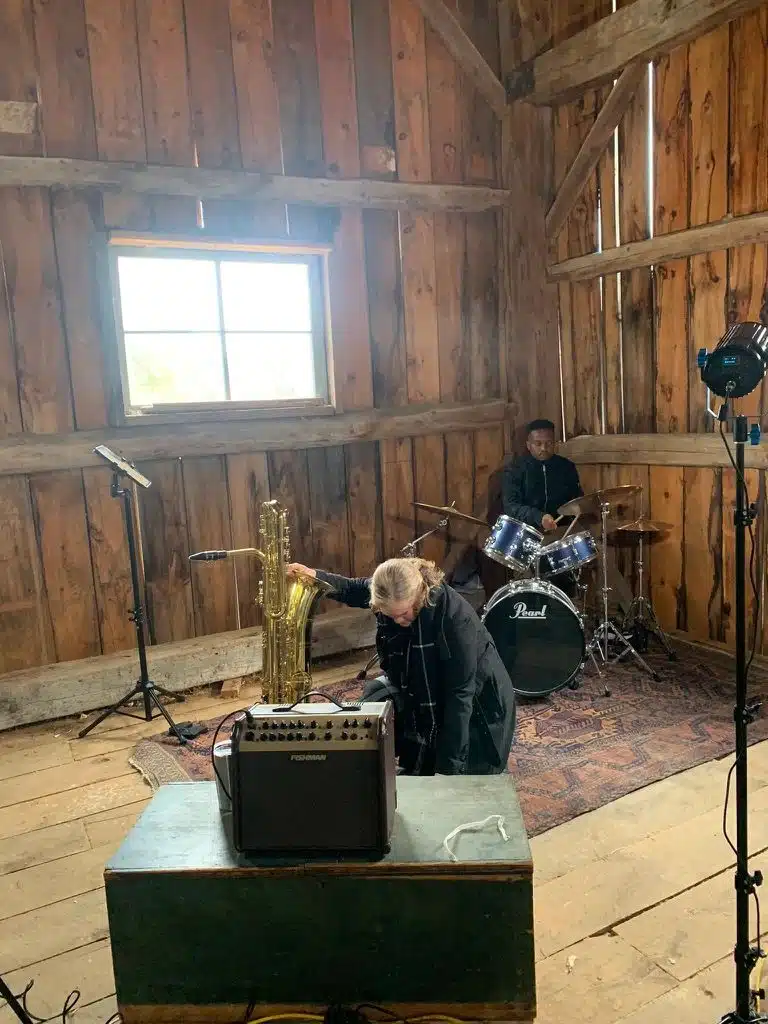
The group that would eventually become the Woodshed Collective started with an ad during the pandemic. Margo answered a call for musicians who loved the sounds of the 1920s and 1930s. Because they could not meet in person, they used online programs to play together from their separate homes. Eventually, as the world began to open up in small increments, they took their instruments to parks and driveways. These outdoor sessions allowed the music to breathe in the open air, a fitting contrast for a vocalist who had spent years indoors in clinical settings.
For Margo, the draw of jazz lies in its refusal to be static. She believes that a singer never needs to be finished with a song. In other genres, a piece might be a museum object, performed the same way every night. In jazz, every performance is a new iteration. While she typically respects the original melody during the first pass of a tune, she views the space after the instrumental solos as a territory for invention. It’s a time when a vocalist is expected to embellish or even completely rewrite the melodic line. This fluidity means the music is always different, reshaped by the mood of the room or the energy of the other musicians.
Jazz’s connection to the past is not just academic for Margo. She carries vivid childhood memories of dance parties where songs like Chattanooga Choo Choo provided the soundtrack. These tunes never truly left her. She finds it fascinating to discover a song that is a century old and realize it still holds a mirror to the modern human experience. She points to universal themes of love and relationship as the reason these standards remain relevant. One of her favourite pieces, Nat King Cole’s Nature Boy, is a personal North Star. She calls it her ‘meaning of life’ song, centred on the idea that the greatest thing one can know is simply to love and be loved in return.
While she respects the history of the Great American Songbook, Margo is also looking toward her own contributions. She’s been writing her own lyrics and plans to work them up with the band for future performances. Her interest remains rooted in the complexities of human relationships and the simple, persistent joy of a silly love song. Now, instead of waiting for a phone to ring with news of a new arrival, she spends her time in the thick of the music, singing about human mysteries and beautiful loves. She has found a way to keep the melody going, and she has no intention of stopping.
Watch the episode:
See more from Margo Seymour:

An inside look at our region's artists, musicians, and venues
Now on its fourth season, Art to Heart is mini-documentary series series directly addresses our mission to support and promote creative professionals, the heart of our creative communities. Journey across western Quebec hearing directly from people creating amazing things.